

Resident Evil Survival Unit: How Capcom Reimagined Survival Horror as Strategy
Resident Evil Survival Unit marks a notable shift for Capcom, taking a franchise built on tension, limited resources, and direct confrontation and adapting it to a strategy-driven mobile format. Rather than copying established horror mechanics, the developers reworked the core ideas of survival horror into systems that reward planning, long-term decision-making, and risk management. This approach reflects broader changes in mobile gaming by 2025, where depth and systemic complexity are no longer limited to console titles.
From Survival Horror Roots to Strategic Design
The original Resident Evil games relied heavily on spatial awareness, scarce ammunition, and constant pressure from hostile environments. Survival Unit translates these ideas into a strategic layer where every action has delayed consequences. Instead of immediate reflex-based combat, players must consider positioning, unit composition, and timing, which mirrors the careful pacing that defined the early entries of the series.
Capcom preserved the franchise’s identity by embedding familiar locations, enemy archetypes, and narrative fragments into the strategic framework. The mansion-like layouts, infected zones, and iconic bio-organic threats are reinterpreted as controllable variables within the strategy system. This allows long-time fans to recognise the atmosphere without relying on jump scares or scripted encounters.
By focusing on preparation rather than reaction, Survival Unit reinforces the idea that fear in Resident Evil has always come from vulnerability. Strategic missteps, such as overextending resources or neglecting defence, recreate that vulnerability in a form suited to mobile play sessions.
Translating Tension into Turn-Based Systems
Tension in Survival Unit emerges through uncertainty and limited information. Fog-of-war mechanics, delayed enemy movements, and incomplete intelligence force players to make decisions without full certainty. This design echoes the anxiety of opening an unknown door in earlier Resident Evil titles, now expressed through strategic risk.
The turn-based structure also allows Capcom to control pacing more precisely. Quiet phases of preparation are followed by sudden escalations, such as enemy outbreaks or timed objectives. This rhythm mirrors the classic survival horror loop of calm exploration followed by moments of intense pressure.
Importantly, failure is not framed as punishment but as feedback. Losing a unit or a zone highlights strategic weaknesses, encouraging adaptation rather than frustration, which aligns well with modern mobile design expectations.
Core Gameplay Systems and Player Agency
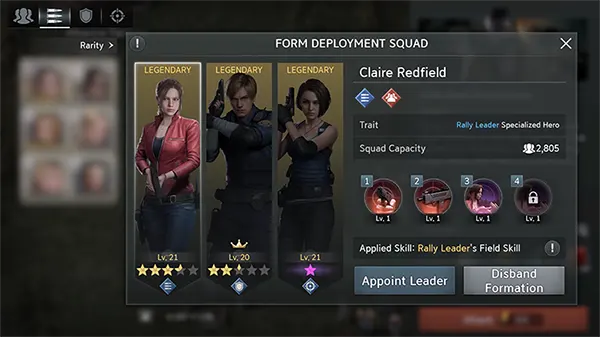
At its core, Resident Evil Survival Unit revolves around base management, squad deployment, and territory control. Players are responsible for developing safe zones, researching upgrades, and assigning characters to missions with specific tactical roles. Each system feeds into the others, creating a layered experience that rewards foresight.
Character progression is deliberately slower than in many mobile strategy games. This pacing reinforces the survival theme, where power is earned gradually and reckless advancement often leads to setbacks. Familiar characters from the franchise are present, but their effectiveness depends on strategic synergy rather than raw statistics.
Player agency is further enhanced by meaningful choices with long-term impact. Decisions about resource allocation, alliance formation, or defensive priorities can alter the difficulty curve hours later, reinforcing the sense that strategy, not speed, determines success.
Resource Management as a Survival Mechanic
Resources in Survival Unit are intentionally constrained. Ammunition, medical supplies, and energy are not just currencies but strategic tools that define possible actions. Overspending in one area can leave critical weaknesses elsewhere, echoing the hard choices of classic survival horror.
The game encourages players to think in terms of sustainability rather than optimisation. Stockpiling resources may offer short-term security but can slow progression, while aggressive expansion risks sudden collapse. This balance reflects real strategic dilemmas rather than artificial difficulty spikes.
By tying resources to narrative context, such as infected regions or abandoned facilities, Capcom ensures that management decisions remain thematically grounded, avoiding abstract systems detached from the Resident Evil universe.
Capcom’s Broader Strategy and the Mobile Market
Resident Evil Survival Unit also represents Capcom’s evolving approach to mobile gaming. By 2025, the mobile audience expects experiences that respect their time without sacrificing depth. Survival Unit addresses this by offering meaningful progression in short sessions while maintaining long-term strategic complexity.
Rather than positioning the game as a simplified spin-off, Capcom treats it as an alternative interpretation of the franchise. This signals confidence in the brand’s flexibility and acknowledges that survival horror concepts can thrive outside traditional action formats.
The game’s design also reflects lessons learned from previous mobile adaptations, avoiding aggressive monetisation mechanics that undermine strategic integrity. Progression remains primarily skill-driven, which supports long-term player trust.
The Future of Survival Horror Beyond Action
Survival Unit demonstrates that survival horror does not depend solely on real-time combat or cinematic presentation. Fear and tension can emerge from systems, uncertainty, and consequence-driven gameplay. This insight may influence future adaptations of horror franchises across different genres.
By embracing strategy, Capcom expands the definition of what Resident Evil can be without eroding its core identity. This approach opens opportunities for experimentation while maintaining consistency with the series’ themes.
As mobile hardware and player expectations continue to evolve, Survival Unit stands as an example of how established franchises can adapt thoughtfully, using design depth rather than spectacle to remain relevant.