

Extinction of the Exaverse: What to Know Before Its September 2026 Mobile Release
Extinction of the Exaverse is an upcoming mobile roguelite that puts evolved dinosaurs on the opposite side of a new extinction event. This time, the danger does not come from an asteroid but from an invading army of AI-controlled machines. Developed by EXA Labs for iOS and Android, the game combines short dungeon runs, tactical movement, temporary character builds and persistent equipment progression in a format designed specifically for phones. As of 24 August 2026, the developer continues to list September 2026 as the intended launch window, although an exact release day has not been announced. Early access testing is already taking place, giving the team an opportunity to adjust its systems before the wider mobile release.
What Extinction of the Exaverse Is Before Its 2026 Release
The central idea is deliberately easy to understand: intelligent dinosaurs are fighting machines that threaten to wipe out their civilisation. Extinction of the Exaverse is presented as a tactical dungeon crawler with roguelite progression rather than a conventional dinosaur survival game. Players do not capture prehistoric creatures, construct a dinosaur park or control a human survivor trying to avoid predators. They directly control an evolved dinosaur known as an Exadon. Each attempt sends that character through a sequence of stages containing GEMS, hostile robots, environmental dangers, equipment and temporary upgrades that can change the character’s abilities for the remainder of the run.
EXA Labs has built the game around relatively short sessions rather than lengthy campaigns that demand an uninterrupted hour of play. The current design uses ten stages for a complete biome run, with the developer estimating roughly 10 to 15 minutes for a successful attempt. The first nine stages combine movement, resource collection and encounters with machines. Players need to mine enough GEMS to activate the way out, but leaving immediately is not always the strongest decision. Staying longer can produce extra resources or useful equipment, while also increasing the chance of losing health or becoming trapped between enemy attack patterns. Stage ten changes the objective entirely by replacing the normal exit requirement with a boss battle.
This structure gives Extinction of the Exaverse a recognisable roguelite rhythm without making the individual systems unnecessarily complicated. A failed or completed run ends the temporary boon build, so the next attempt begins with a new combination of choices. Equipment works differently because collected gear can remain available between runs and improve areas such as Attack or Defence. The separation matters: temporary boons provide variety from one attempt to another, while equipment gives players a longer-term reason to keep progressing. It also means failure does not necessarily leave a player exactly where they started, which is an important distinction between this game and a stricter traditional roguelike.
How a Ten-Stage Exaverse Run Actually Works
A run begins by establishing a build direction and then sending the player’s dinosaur into the first dungeon stage. Movement, attacking and GEM mining use the same compact control philosophy, so the focus is less on memorising a complicated command layout and more on deciding where to move next. GEMS have an immediate practical purpose because enough of them must be collected to open the stage exit. Yet the shortest route is not automatically the safest or most rewarding one. A nearby robot might control the direct path, another section of the map might contain a useful powerup, and extra GEMS can support the developing build. Each stage therefore creates a small risk-versus-reward decision before the player moves on.
Boons provide most of the run-to-run variation. They are temporary upgrades chosen as an attempt progresses and can alter attacks, improve survivability or create connections between other abilities. At the beginning of a run, players choose an Instinct that encourages a particular style without completely locking the character into it. Later boon offers can reinforce that direction or push the build towards something different. Because the temporary setup disappears after the run, a combination that worked particularly well against one group of robots cannot simply be carried permanently into every future attempt. The player has to work with the choices provided during the current run.
The final stage tests how well those decisions have come together. For the first season’s Jungle biome, the current boss is Amethyron, Warden of the Wild. Reaching this fight with plenty of health but a poorly connected set of boons can be less useful than arriving with a coherent build whose abilities complement each other. Persistent equipment adds another consideration because stronger gear can make later attempts more manageable even when the temporary boon selection changes. The resulting loop is straightforward enough for a short phone session, yet it contains enough variation in routes, upgrades, enemies and equipment drops to prevent every ten-stage run from following exactly the same pattern.
Dinosaurs, AI Robots and the Story Behind the Exaverse
The setting starts from an alternative-history idea: what would have happened if the asteroid associated with the extinction of non-avian dinosaurs had never struck Earth? In the game’s fiction, dinosaurs survive on a parallel Earth and continue evolving for millions of years. They eventually develop intelligence, cultures and technology, becoming the Exadons. Their civilisation is closely connected to powerful GEMS buried throughout their planet. The situation changes when mysterious machines arrive and begin harvesting those energy-rich resources. Settlements collapse, ecosystems are damaged and the Exadons find themselves facing the kind of extinction their ancestors escaped.
The story eventually connects the Exadons’ dimension with present-day humanity. According to the current lore published by EXA Labs, an attempt to establish contact between the two dimensions goes wrong and 4,578 Exadons are displaced into our Earth. Researchers then become involved in attempts to restore a stable connection and understand the machines consuming the Exadons’ home. This background gives the robot battles a clearer purpose than simply supplying enemies for each stage. GEMS are simultaneously resources used during gameplay and part of the reason the machine army invaded, while ruined environments and different biomes can reflect what has happened to the civilisation that lived there.
The first playable Exadon is Pax, a character inspired by Parasaurolophus. That choice immediately separates the game from the usual reliance on Tyrannosaurus rex or Velociraptor as the lead dinosaur. The real Parasaurolophus was a large Late Cretaceous herbivore recognisable by its long cranial crest, but Pax is deliberately not presented as a scientifically accurate reconstruction. He is an intelligent, technologically capable descendant of dinosaurs who can use equipment and specialised abilities. The familiar crest and body shape create the connection to the real animal, while the combat mechanics turn Pax into a character suited to the science-fiction setting rather than a prehistoric simulation.
How Pax Fights the Machines in Season One
Pax currently has three main powerups that cover clearly different combat situations. RAZOR CLAW concentrates damage on an individual opponent, making it particularly relevant when a dangerous robot or boss needs to be dealt with quickly. STAMPEDE is intended for situations in which several machines are occupying the same area and a wider attack is more valuable than concentrated damage. SHIELD provides temporary protection and can help Pax survive a dangerous sequence, cross a threatening part of a stage or recover from a positioning mistake. The basic purpose of each ability is simple, which keeps the moment-to-moment combat understandable on a small screen.
The depth comes from the way boons can modify those familiar abilities. Pax has a lightning-oriented set of character upgrades that can add electrical effects to RAZOR CLAW, STAMPEDE and SHIELD. Other effects can make lightning jump between enemies, repeat against the original target or become stronger as a sequence continues. A player therefore does not need an entirely new collection of buttons every time the build changes. The same core powerups remain recognisable, but their results can become substantially different over the course of a run. One attempt might favour concentrated boss damage, another can focus on groups of machines, while a defensive setup can turn successful blocks into opportunities for counterattacks.
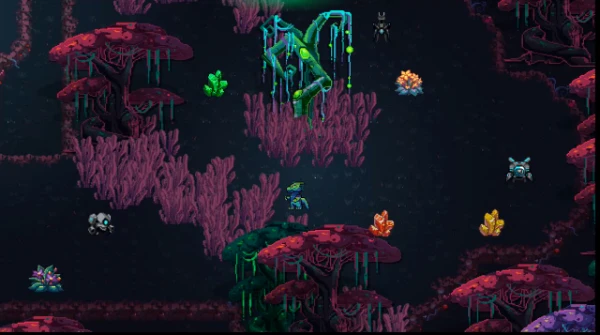
Season One places Pax in the Jungle, where the environment is part of the tactical problem rather than scenery alone. Current build information shows that Jungle traps can interact with certain boons, allowing environmental hazards to become useful against machines under the right conditions. This gives players another option besides attacking every robot directly. The first biome therefore acts as an introduction to several parts of the design at once: Pax’s abilities, machine movement, GEMS, temporary builds, equipment and hazards that can affect the route through a stage. At the end of the ten-stage sequence, Amethyron provides the main test of how effectively those elements have been combined.
What Mobile Players Should Know Ahead of the September Launch
Extinction of the Exaverse is being made specifically for iOS and Android rather than treating phones as a secondary version of a larger-screen game. The display is vertical, and EXA Labs says the controls are designed to work with one hand. Players can use directional tap controls when they want more deliberate movement, while a swipe-based option supports faster continuous movement through a stage. Attacks, mining and interactions remain deliberately simple. This arrangement suits the short-run structure because a session can begin without learning a large number of touch gestures or rearranging virtual controls across most of the screen.
The developer is also targeting relatively modest device demands. The official game information refers to an 8-bit-inspired visual style and low memory requirements, with the intention of supporting a broad range of mobile hardware. Core gameplay is designed to work offline, and a login is not required simply to begin playing. An account becomes necessary for in-app purchases. Offline support could be particularly useful for the 10-to-15-minute structure because it allows normal dungeon runs to fit situations in which a reliable connection is unavailable. The exact performance range across different phones will still need to be judged after the public release, when a much larger variety of devices is running the final build.
As of 24 August 2026, September remains the official launch window shown by both the main game site and EXA Labs’ current digital-ownership documentation. No precise September date is stated in those sources, so any more specific release date should be treated cautiously unless the developer publishes an updated announcement. Early access remains available through Immutable Play, and testing has already been used for systems including Pax, the Jungle and the evolving dungeon structure. That distinction is important because values, balance, available boons and other details seen before launch can still change. Information tied to the current build should not automatically be treated as permanent launch-day behaviour.
Why Extinction of the Exaverse Stands Out Among 2026 Mobile Roguelites
The most immediate difference is its theme. Dinosaur games on mobile commonly centre on collection, park management, hunting or survival, whereas Extinction of the Exaverse turns the dinosaur into the playable science-fiction hero and robots into the invading threat. The idea is unusual, but the underlying gameplay remains familiar enough to understand quickly: move through stages, gather resources, choose upgrades, fight or avoid enemies, improve equipment and prepare for a boss. That balance between a distinctive setting and a recognisable run-based structure may be more important than simply adding additional systems. The game does not need players to understand its full lore before the first dungeon run makes sense.
Its other notable characteristic is the attempt to combine casual mobile controls with decisions that matter from turn to turn. A one-handed game can easily become mechanically shallow, while a detailed roguelite can become awkward on a phone if too many actions compete for screen space. Extinction of the Exaverse is trying to sit between those extremes. The controls themselves remain simple, but positioning, enemy attack patterns, GEM routes, powerup timing and boon choices can create consequences later in the run. Persistent equipment then provides a longer progression layer without removing the need to assemble another temporary build on the next attempt.
There are still reasonable questions that cannot be answered fully before release. Long-term balance, equipment progression, seasonal pacing, monetisation and the variety of later biomes will be easier to judge after the public version has been available for some time. EXA Labs also intends to use blockchain-backed infrastructure for a limited group of digital ownership features, including certain seasonal reward records and collectibles, although its current documentation states that crypto knowledge or trading is not required to play. For now, the confirmed picture is narrower and more useful: Extinction of the Exaverse is a one-handed iOS and Android roguelite built around 10-to-15-minute dinosaur dungeon runs, with Pax and the Jungle leading its planned September 2026 release.