
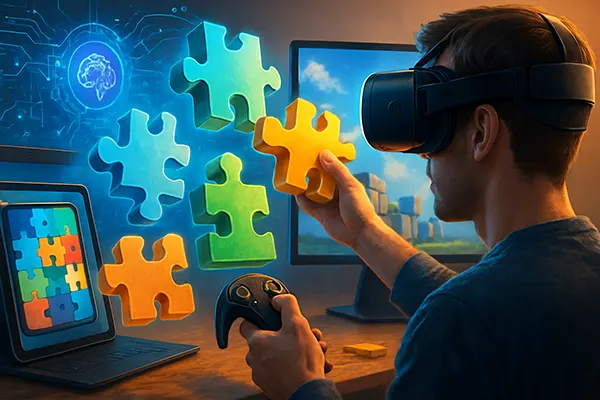
Trends in Puzzle Games 2025+: AI, Visual Innovation, VR and the Future of the Genre
Puzzle games continue to evolve faster than ever, shaped by technological innovation, new interactive principles, and behavioural shifts among players. By 2025, the genre has expanded far beyond traditional match-three mechanics or static brainteasers. Studios now focus on adaptive systems, immersive worlds, and design methods that blend logic with storytelling, exploration, and emotional engagement. This article analyses the shifts driving modern puzzle design and the direction the genre is likely to take in the coming years.
AI-Driven Puzzle Design and Dynamic Difficulty
Artificial intelligence has become one of the most influential forces behind puzzle development. By 2025, many studios integrate machine-learning models capable of observing a player’s decisions, identifying patterns of behaviour, and adjusting game challenges accordingly. Instead of fixed difficulty levels, puzzles evolve in real time, allowing each session to remain balanced and fair without causing frustration or monotony.
Developers also use AI to generate unique puzzle layouts that cannot be repeated manually. Procedural structures built on neural networks create scenarios that feel both logical and surprising. This technology gives designers more freedom to focus on theme, narrative, and user experience, while automated systems handle complexity and variation at scale.
AI additionally assists in predicting accessibility needs. Puzzle games now adapt timing, contrast, interaction methods, or step-by-step guidance based on a user’s gameplay profile. Such systems make the genre more inclusive without removing challenge, encouraging broader audience engagement.
How AI Changes Creative Approaches
The creative process itself has shifted. Studios increasingly rely on AI-assisted testing to understand how players interpret clues, spatial layouts, and progression curves. These tools show where users hesitate, where they rush, and how they respond to new mechanics. As a result, design teams refine puzzle logic earlier in development, improving clarity and reducing the risk of poorly communicated rules.
AI also supports narrative integration. Story-driven puzzles can now respond to player decisions, enabling branching outcomes or personalised story beats. This approach transforms puzzles from isolated tasks into meaningful components of world-building, helping the genre appeal to audiences who value depth and emotional cohesion.
Finally, machine-learning systems help creators maintain long-term content cycles. Seasonal updates, expansions, or new puzzle packs can be generated and validated faster, providing players with a steady flow of authentic challenges that feel handcrafted rather than repetitive.
Visual Evolution: Hyper-Clean Graphics, 3D Depth and Motion Interaction
Visual trends in puzzle gaming evolve alongside hardware capabilities. By 2025, mobile devices and handheld consoles support greater texture fidelity, smoother animations, and wider colour spaces, allowing creators to explore more subtle visual identity. Puzzle games now often pursue clean, elegant design where clarity is the priority. This ensures that problem-solving remains intuitive, even in graphically rich environments.
With growing support for 3D rendering, many modern puzzles incorporate spatial depth as a core mechanic. Players rotate structures, reposition elements in full three-dimensional space, or manipulate objects using physics-driven interactions. These ideas strengthen cognitive involvement and expand the genre beyond traditional flat-board layouts.
Motion-sensitive features also become more common. Devices capable of precise gesture tracking allow players to twist, tilt, lift, or rearrange pieces naturally. This approach encourages more tactile problem-solving and enhances immersion while still ensuring accessibility for players who prefer standard touch-based controls.
The Role of Art Direction in Modern Puzzles
Art direction now carries more weight in shaping the emotional tone of puzzle games. Developers focus on cohesive visual identity: minimalist interfaces, purposeful colour palettes, and thematic symbolism that complements each puzzle’s logic. This strengthens comprehension and reduces cognitive noise, making complex challenges feel more approachable.
Texture detail and animation flow influence player satisfaction as well. Smooth transitions, responsive feedback, and subtle sensory cues help guide decision-making without overwhelming the player. These elements have become essential tools for reinforcing clarity and enhancing comfort during longer sessions.
Furthermore, the integration of dynamic lighting and environmental effects creates atmospheric puzzle environments that feel alive. These visual details provide context and reinforce thematic storytelling, helping the genre connect with players who appreciate world-building alongside logic-based tasks.
VR, AR and Hybrid Puzzle Experiences
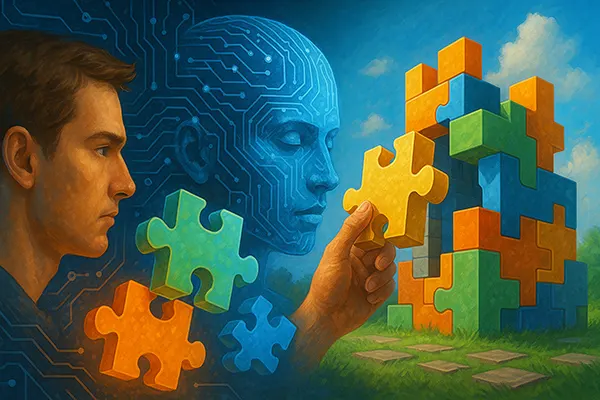
Headsets available in 2025 offer higher frame rates, lighter builds, and improved hand-tracking, making VR puzzle games more accessible and stable. Spatial challenges that require players to move around real-scale objects or manipulate multi-layer structures have gained popularity thanks to advances in room-mapping and precise interaction systems.
Augmented reality continues to expand, especially through mobile devices that support advanced sensors. AR puzzles overlay logic structures onto physical surfaces, turning everyday surroundings into interactive playfields. This hybrid approach encourages creativity and physical engagement while maintaining the cognitive depth the genre is known for.
Mixed-reality integration also emerges as a powerful design method. Games now switch seamlessly between digital puzzles and real-world contexts, using environmental data such as angles, textures, or movement to shape challenges. This style emphasises active problem-solving and brings puzzle mechanics closer to real-world exploration.
The Future of Immersive Puzzle Formats
Hybrid formats are opening opportunities for collaborative puzzle-solving. Multiplayer VR puzzle rooms allow players to cooperate in shared digital spaces, each contributing perspective or handling specific tasks. This supports social interaction and creates new layers of complexity that cannot be replicated in traditional single-player formats.
In AR environments, contextual puzzles adapt to location, lighting conditions, and user behaviour. This flexibility allows designers to build experiences suitable for both indoor and outdoor play, widening potential use cases such as educational tasks, creative challenges, or thematic campaigns.
As mixed-reality hardware matures, the boundary between physical and digital elements will continue to blur. Puzzle designers are expected to focus on meaningful interaction rather than novelty, ensuring that immersive formats serve the puzzle’s logic rather than overshadow it.